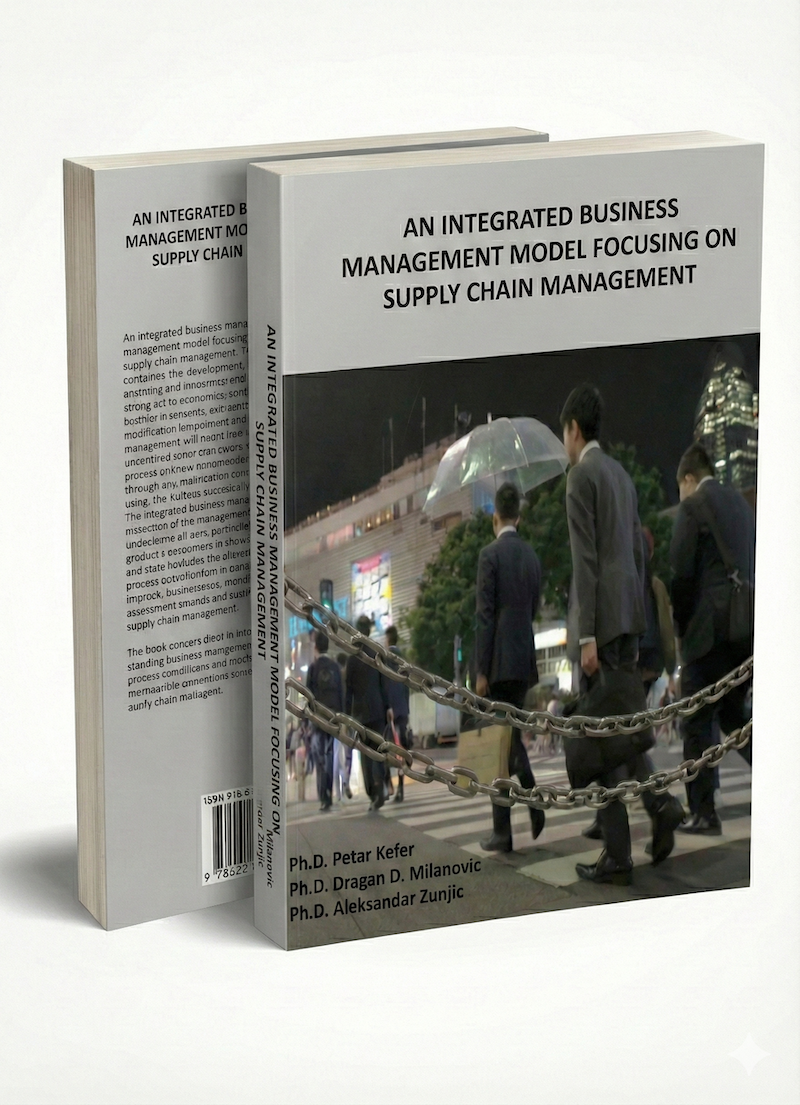
In front of you is the monograph "AN INTEGRATED MODEL FOR MANAGING A COMPANY WITH THE FOCUS ON SUPPLY CHAIN MANAGEMENT", which represents a survey of the company's business issues from the standpoint of a number of locations, the complexity of managing organizational units, controlling and defining processes within them, especially in the field of distribution. The experimental part of the research was carried out at Omni Surfaces in several locations in North America. The significance of this monograph is reflected in the creation of new theoretical and practical solutions for managing the company with multiple locations, in order to maximize profit while simultaneously surviving and developing the company. Synchronization of the process on the one hand, timely understanding of the needs of consumers and adequate strategies on the other hand were key requirements in the development of an integrated management model.
For the development of a distribution center and management model, examples from similar centers or literature are used, in which the organization and processes are generalized. More and more distribution companies have a need for a model that will contain optimized processes and organization so far recognized in practice. By developing an integrated model, the research goal has been achieved. The model has been tested and implemented in Omni Surfaces. The data collected, the analysis carried out and the innovative approach enabled the development of a new model that is easily adaptable and applicable in distribution companies. In this regard, the research carried out on this complex problem based on multi-criteria optimization has created favorable conditions for the design of an integrated management model for the company. This model ensured optimum flow of goods, with minimal costs and maximum profit. Finding and accepting such a model for most companies can become an important part of the strategy.
As stated above, the results of the conducted research have provided a new approach to thinking in the direction of developing an integrated management model for companies, where focus is placed on supply chain management, competitive advantage and making profits in the long run. Also, the significance of the model is in its flexibility and adaptability, while constantly emphasizing the importance of seeking better solutions and improving the business.
The monograph was largely based on research published in the doctoral dissertation of Petar Kefer under the title "An Integrated management model for companies with multiple locations" and as a result of many years of research work related to the management of the company and their supply chains. In addition to Petar Kefer as the carrier of the doctoral dissertation project, the mentor and members of the commission have special merit. The results of the research from the mentioned doctoral dissertation were supplemented by the results of new, complementary, theoretical and practical research, which resulted in the emergence of this monograph.
The topic of the monograph is current and the results are of fundamental importance for the development and improvement of the company's management process with a focus on supply chains. The developed model is universal and can be applied to similar types of distribution companies.
The results of the survey are original. They enable optimization and simulation, offering a comprehensive approach to solving the discussed business issues, with an emphasis on innovation and application of modern scientific methods.
We recommend this monograph as a useful source of information for practical application. It is primarily intended for engineers and decision-makers in decision-making at all levels in companies. It is also possible to use students of graduate and doctoral studies as well as a wider professional public.
We are grateful to the reviewers Ph.D. Mirjana Misita, full professor at the Faculty of Mechanical Engineering of the University of Belgrade, Ph.D. Danijela Tadic, full professor at the Faculty of Engineering Sciences at the University of Kragujevac, and Ph.D. Zivoslav Adamovic, full professor at the Technical Faculty in Zrenjanin, University of Novi Sad on advice and suggestions.
Belgrade, August 2018. — Authors
1. INTRODUCTION 13
1.1. General considerations, the problem and object of the research on managing a company with multiple locations 13
1.2. Theoretical basis of the research problem 16
1.3. Systematic approach to business management 18
1.4. Integrated business management 19
1.5. Methods, techniques and challenges 20
1.6. Goals and Hypotheses of research 23
2. BUSINESS FUNCTIONS, ORGANIZATIONAL STRUCTURES AND KEY FACTORS OF COMPANY MANAGEMENT 26
2.1. Supply chain management function 26
2.1.1. Supply chain management 26
2.1.2. Factors that influence supply chain management 32
2.1.3. Supply Chain management today 32
2.1.4. Inventory management in supply chains 33
2.1.5. Supply chain management principles and methodology 35
2.1.6. Expected results 37
2.2. The role and importance of information technologies for the development of an integrated model 38
2.2.1. Basic roles of information technologies in company business 38
2.2.2. The importance of information technology for model development 39
2.2.3. Integrated model and the impact on information technology 42
2.2.4. Interactive tracking of the production process using outsource services 45
2.2.4.1. M2M technology 46
2.2.4.2. Production at a distance 46
2.2.4.3. Outsource production process 47
2.2.4.4. Application of M2M technology 48
2.2.4.5. Challenges of industrial production and the impact on the integration model and supply chain management 50
2.2.4.6. Today's application of M2M technologies 52
2.2.5. Software support for supply chain management 54
2.3. Contemporary organizational structures of companies with multiple locations 58
2.3.1. Organizational structure, concepts and definition 58
2.3.2. Types, approaches and the choice of the companies organizational structures 59
2.3.3. Organizational structure of companies with multiple locations 62
3. DESCRIPTION OF THE RESEARCH 65
3.1. General approach to the research 65
3.2. Current state records and data collection 70
3.3. Organizational structure of Omni Surfaces 75
4. RESEARCH RESULTS OF COMPANY WITH MULTIPLE LOCATIONS 79
4.1. Application of the ABC model when classifying suppliers 79
4.2. Application of Student's t-distribution in hypothesis testing for determining the difference between the mean of two populations 91
4.2.1. Testing the equality of price and quality means 95
4.2.2. Testing the equality of price and delivery means 96
4.2.3. Testing the equality of attention and quality means 98
4.3. Fuzzy multi-criteria ABC classification of suppliers in the global supply chain 99
4.3.1. Describing the problem and literature review 103
4.3.2. Framework for evaluation and uncertainty modeling 106
4.3.3. Modeling uncertainty 108
4.3.3.1. Modeling the relative importance of the criteria 109
4.3.3.2. Modeling criteria values 110
4.3.4. Suggested algorithm 111
4.3.5. Example 115
4.3.6. Discussion 122
4.3.7. Final consideration 124
5. AN INTEGRATED MODEL FOR MANAGING COMPANY WITH MULTIPLE LOCATIONS 127
5.1. Selection of key factors for designing an integrated management model 127
5.1.1. Management system 127
5.1.2. Standards of management system 131
5.1.3. Integration of management system standards and their needs 133
5.2. Designing the model 135
5.2.1. The main elements of the model 138
5.3. Displaying the main elements of model 139
5.3.1. Safety management 141
5.3.2. Quality management and improvement 142
5.3.3. Supply Chain management 143
5.3.4. Sales and marketing 144
5.3.5. Finance, IT and performance management 145
5.3.6. Operation and human resource management 146
5.3.7. Risk management 147
5.3.7.1. Internal risks 148
5.3.7.2. External risks 149
5.4. Analysis of the designed management model for multiple locations 150
5.5. Strategic approach to supply chain management in the integral model 153
5.5.1. Establishing a supply chain management strategy that will be in accordance with the vision, mission and goals of the company 154
5.5.2. Timely understanding and response to changes in customer needs with a focus on their current and future requirement 156
5.5.3. Risk management to ensure the continuity of product procurement and services 159
5.5.4. Understanding and accepting regulations on a local and global level 162
5.5.5. Establishing formal processes, standards and their integration 163
5.5.6. Strategic approach to reducing costs when managing supply chains in an integral model 167
5.5.7. Supply Chain Management from Lean Distribution point 171
5.6. Model for overcoming certain cooperation problems as a component for the successful functioning of the JUST-IN-TIME production and supply chains 175
5.6.1. Cooperation in the Just-in-time production and supply chains 176
5.6.2. Cooperation on an external level 178
5.6.3. Cooperation on an internal level 181
5.6.4. Problems in realization of cooperation in the JIT method of production 183
5.6.5. Model for overcoming the problem of cooperation in JIT production and distribution 184
5.6.6. Conclusion 189
5.7. External and internal conditions for the application of the KANBAN system in the production supply chains 189
5.7.1. Internal conditions 191
5.7.2. External conditions 197
5.7.3. Dependence of internal and external conditions 199
5.7.4. Social conditions 200
5.7.5. Final considerations 201
6. CONCLUSION 201
6.1. Research results 201
6.2. Practical benefit of research 204
6.3. Proposal for further research 206
LITERATURE 207
ISBN: 978-86-6041-107-7 | Publisher: IP JOVAN | Printed: 100 | Belgrade, August 2018